
15 Practical Scholarship Interview Tips for Students to Succeed
Knowing what you want to say is only part of performing well in a scholarship interview. The way you communicate your experiences, respond to follow-up questions, handle difficult moments, and explain your goals can make a significant difference.
The most useful scholarship interview tips are not about trying to appear perfect. They are about giving clear, genuine answers supported by real experiences while showing that you can listen, think, and communicate effectively.
Whether this is your first interview or you have interviewed for scholarships before, the following tips can help you handle the conversation with greater control and confidence.
Table of Contents
15 Practical Scholarship Interview Tips
1. Listen to the Entire Question Before Answering
One of the easiest mistakes to make is answering before you have fully understood the question.
Students sometimes hear the first few words of a question and immediately begin using a response they prepared earlier. This can lead to an answer that sounds polished but does not actually address what the interviewer asked.
Use a simple approach: Pause → Understand → Answer
A short pause of a few seconds is completely acceptable. Make sure you understand the question before deciding which experience or example is relevant.
If the question is unclear, you can politely ask the interviewer to clarify it rather than guessing.
2. Answer the Question You Were Actually Asked
Preparation is useful, but over-preparation can become a problem when you try to fit every question into a memorized speech.
For example, if the interviewer asks about a challenge you faced, immediately giving a long explanation of your academic achievements does not answer the question.
Before responding, mentally identify the main subject of the question. Then give the information that directly addresses it.
Think: Question → Relevant point → Evidence → Result
This keeps your answer focused and prevents prepared material from taking over the conversation.
3. Use Specific Examples Instead of Generic Claims
Statements such as “I am hardworking,” “I am passionate,” or “I am a good leader” do not tell the interviewer much by themselves.
Support important qualities with evidence.
A useful structure is: Claim → Example → Result
Instead of simply saying you are a strong leader, briefly describe a situation where you took responsibility, explain what you did, and mention what happened as a result.
The example does not need to be dramatic. A school project, volunteer activity, academic assignment, part-time job, or community activity can demonstrate useful qualities when you explain your actual contribution.
4. Keep Your Answers Focused
A strong answer does not have to include everything you have ever accomplished.
Trying to mention every award, activity, course, or volunteer experience can make an answer difficult to follow.
For most questions, focus on:
- The point you want to make
- One or two relevant details
- A specific example
- The result or lesson
If the interviewer wants more information, they can ask a follow-up question.
Think of your first answer as opening the conversation, not delivering your entire personal history.
5. Tell Stories, Not Just Lists of Achievements
A list of achievements tells the interviewer what you did. A short story can show how you approached a situation and why it mattered.
For example, instead of saying, “I volunteered at a community center,” explain the situation briefly, what responsibility you took, what changed because of your involvement, and what you learned.
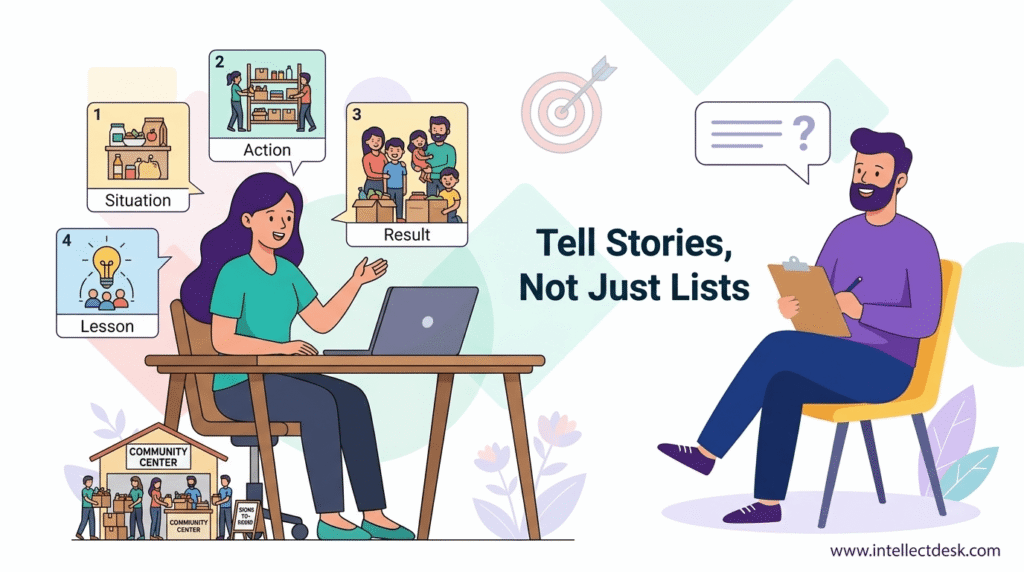
A useful structure is: Situation → Action → Result → Lesson
Keep the story focused on your role. Avoid spending most of the answer describing what other people did.
This approach can make your experiences easier for the interviewer to understand and remember.
6. Let Your Personality Come Through
A scholarship interview is not a written application read aloud.
Your answers should sound like something you would actually say in a conversation. Use vocabulary that feels natural to you and explain experiences in your own words.
Professional does not mean robotic.
If an academic project excited you, explain why. If a volunteer experience changed how you think about your community, explain that naturally. Genuine enthusiasm is more useful than trying to sound impressive in every sentence.
You are giving the committee an opportunity to understand the person behind the application.
7. Do Not Memorize Answers Word-for-Word
Memorized scripts can make it harder to respond when an interviewer changes the wording of a question.
Instead of remembering complete paragraphs, remember:
- Your main point
- Relevant examples
- Important facts or numbers
- The result of an experience
- What you learned
- Your broader goal
This gives you enough structure to stay focused while allowing your wording to change naturally.
If you have already worked on your preparation using a scholarship interview preparation guide, use those notes as a foundation rather than treating them as a script.
8. Handle Follow-Up Questions Well
Follow-up questions are not necessarily a sign that your first answer was weak. In many cases, the interviewer simply wants to understand your experience more deeply.
You may hear questions such as:
- “What did you learn from that?”
- “Why did you choose that approach?”
- “What would you do differently?”
- “Can you tell us more about that experience?”
Use this simple approach: Listen carefully → Connect to your original point → Add useful detail
If you mentioned leading a project and the interviewer asks what you learned, do not start an unrelated story. Return to the project and explain the specific lesson.
Good follow-up answers demonstrate that you understand your own experiences rather than simply remembering prepared statements. If you want to avoid mistakes, this guide, Common Interview Answers to Avoid Mistakes, can help you.
9. Be Honest When You Do Not Know Something
You may occasionally receive a question you cannot answer immediately. Do not invent facts, exaggerate your knowledge, or pretend to understand something you do not.
If appropriate, acknowledge the limitation and explain how you would approach finding the answer.
For example: “I’m not familiar enough with that topic to give you an accurate answer, but I would research it by looking at reliable sources and speaking with someone experienced in the field.”
Honesty is particularly important in scholarship interviews because your answers should remain consistent with the information in your application.
10. Turn Nervousness Into a Manageable Problem
You do not need to eliminate nervousness completely before an interview.
Instead, control what you do when you feel nervous.
Before answering a difficult question, take a slow breath and allow yourself a brief pause. Concentrate on the question in front of you rather than worrying about how the entire interview is going.
Other practical techniques include:
- Practice speaking aloud before the interview.
- Use key points instead of memorized scripts.
- Pause rather than filling every silence with “um” or “so.”
- Focus on one question at a time.
- Accept that a little nervousness is normal.
The goal is not to look completely emotionless. The goal is to remain capable of communicating even when you feel nervous.
11. Avoid Comparing Yourself With Other Applicants
Scholarship selection can be competitive, but you do not need to criticize or rank other applicants to demonstrate your value.
Statements such as “I deserve this more than everyone else” can come across as dismissive.
Instead, explain your own:
- Experiences
- Achievements
- Goals
- Circumstances
- Contributions
Let the selection committee make comparisons. Your responsibility is to explain what makes your own journey and goals meaningful.
For detailed guidance on answering questions about your suitability for a scholarship, see the dedicated guide to Why Do You Deserve This Scholarship?
12. Explain Weaknesses and Setbacks Honestly
Interviewers may ask about a difficult academic period, a failed project, a missed opportunity, or a mistake.
Do not try to pretend that you have never struggled.
A useful way to discuss a setback is: What happened → What I did → What I learned → What changed
Spend less time making excuses and more time explaining your response.
For example, if you performed poorly in a particular subject, you could explain what caused the difficulty, what steps you took afterward, and how your study habits changed.
The important part is not presenting yourself as someone who never makes mistakes. It is showing that you can learn from them.
13. Show That You Understand Why the Scholarship Matters
You should be able to explain naturally how the scholarship connects with your education and future plans.
Think about the relationship between: Scholarship → Education → Goals → Impact
For example, financial support might allow you to reduce work hours and spend more time on your studies. A scholarship might also provide access to mentoring, professional networks, research opportunities, or a community related to your field.
Do not simply repeat the scholarship’s description. Explain what the opportunity would actually mean for you.
If your goals are the main focus of your answer, the dedicated What Are Your Career Goals? Scholarship Interview Answers guide can provide more detailed question-specific support.
14. Prepare for Unexpected Questions
Even with excellent preparation, you cannot predict every question.
An interviewer may ask a hypothetical question, challenge an assumption, ask about a failure, or follow up on something unexpected in your application.
When this happens, do not rush.
Use: Pause → Think → Structure → Answer
You can take a moment to organize your thoughts. If necessary, start by identifying the main point you want to make and then support it with an example or explanation.
You do not need to produce a perfect answer instantly. A thoughtful response is usually better than a rushed one.
15. End the Interview Strongly
The final moments of an interview are an opportunity to leave the conversation on a professional note.
If the interviewer invites you to ask questions, use one of the genuine questions you prepared. Listen carefully to the response rather than treating the question as a formality.
At the end, thank the interviewer for their time and the opportunity to discuss the scholarship.
You do not need a dramatic closing statement. A sincere and professional ending is enough.
How to Answer When You Need Time to Think
Sometimes your mind goes blank even when you know the subject.
Do not panic or start talking simply to fill the silence.
You can use natural phrases such as:
- “That’s a thoughtful question. Let me think for a moment.”
- “One experience that comes to mind is…”
- “I would approach that by…”
Then take a moment to organize your response.
A short pause is better than giving a long, unfocused answer because you are afraid of silence.
Try not to rely on the same filler phrase repeatedly. The purpose is to give yourself time to think, not to replace thinking with filler words. Check out the list of 35+ Scholarship Interview Questions and Answers to Help You Succeed.
What to Do After a Mistake During the Interview
Making a small mistake does not automatically ruin an interview.
You might give an unclear answer, forget a detail, misunderstand a question, or lose your train of thought.
Use: Clarify → Correct → Continue
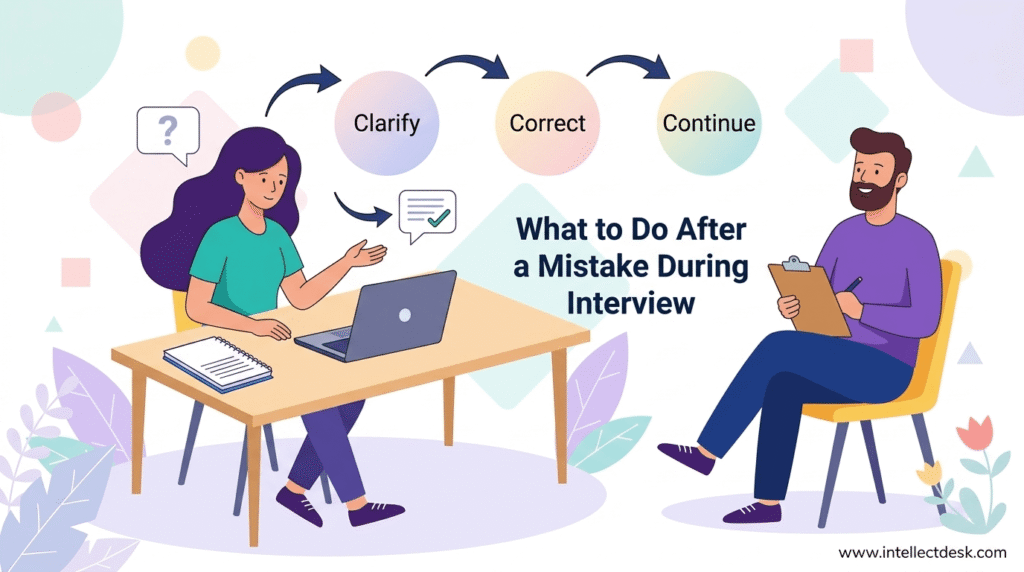
If you misunderstood the question, politely ask for clarification. If you gave an incorrect detail, correct it when you notice it. If you lose your train of thought, briefly pause and return to your main point.
For example: “Let me clarify that. What I meant was…”
Then continue.
Avoid spending the next several minutes apologizing for a small mistake. Correct it and move forward.
Scholarship Interview Body Language: Keep It Natural
Body language should support your communication, not become another performance you have to manage.
During an in-person interview:
- Sit comfortably and attentively.
- Maintain natural eye contact.
- Avoid constantly looking down.
- Use natural facial expressions.
- Keep gestures moderate.
- Pay attention while the interviewer is speaking.
- Do not force a smile throughout the interview.
For online interviews, look toward the camera when appropriate and avoid constantly watching your own video preview.
The goal is to appear attentive and comfortable, not perfectly controlled.
Scholarship Interview Tips for Online Interviews
Virtual interviews create a few additional challenges. Here are a few interview tips for you.
During the conversation:
- Keep your microphone unmuted only when appropriate.
- Close distracting applications and notifications.
- Keep your camera positioned properly.
- Use a quiet location.
- Keep important notes nearby without constantly reading them.
- Look toward the camera when speaking for periods of time.
- If the connection fails, reconnect calmly or follow the backup instructions provided.
If you experience a technical problem, explain it briefly rather than panicking. For example, you can say, “I’m sorry, I think the connection briefly dropped. Could you repeat the last part of the question?”
Good online scholarship interview performance is mostly about removing avoidable distractions so you can concentrate on the conversation.
Scholarship Interview Tips for Students Who Are Very Nervous
If scholarship interviews make you particularly nervous, focus on actions rather than trying to force yourself to “be confident.”
Practice answering questions aloud instead of only writing responses. Prepare a small number of meaningful experiences that you can discuss from different angles. During the scholarship interview, concentrate only on the question currently being asked.
If you need a moment, pause.
If you make a mistake, recover and continue.
If you do not know something, be honest.
Remember that the goal is not to deliver a flawless performance. You are trying to communicate your experiences, goals, and reasons for applying clearly enough for the committee to understand you.
Quick Do and Don’t
|
Do |
Don’t |
||||||||||||||||
|
|
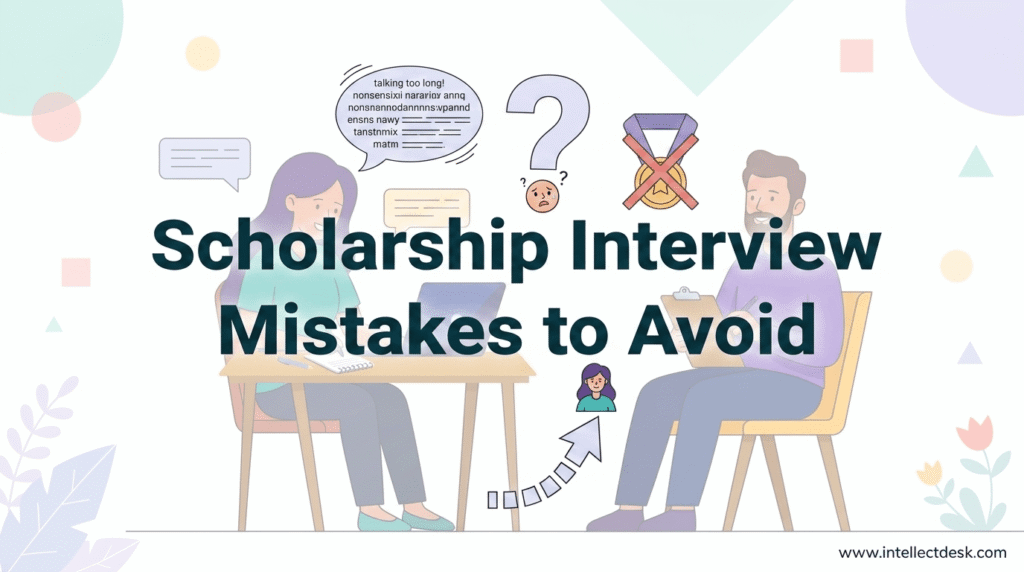
Scholarship Interview Mistakes to Avoid
Keep these mistakes in mind during the scholarship interview:
- Giving rehearsed answers instead of responding naturally.
- Talking for too long without making a clear point.
- Using vague claims without supporting examples.
- Failing to answer the actual question.
- Exaggerating achievements or responsibilities.
- Speaking negatively about other applicants.
- Being unable to explain the information included in your application.
- Ignoring or avoiding follow-up questions.
- Panicking after a small mistake.
- Forgetting to show genuine interest in the scholarship opportunity.
The goal is not to avoid every possible mistake. It is to recognize when something goes wrong and recover without allowing one difficult moment to affect the rest of the interview.
Frequently Asked Questions
What are the best scholarship interview tips?
Listen carefully, answer the question directly, use specific examples, speak naturally, and support important claims with real experiences. Prepare enough to stay organized without memorizing complete scripts.
How can I make a good impression in a scholarship interview?
Focus on being clear, genuine, and relevant. Explain your experiences with specific evidence and show how the scholarship connects with your education and goals. Avoid trying to impress the interviewer with exaggerated claims.
How do I stop sounding rehearsed in a scholarship interview?
Do not memorize complete answers. Remember your main points, examples, results, and lessons instead. Practice explaining the same experience in different ways so you can adapt to the actual wording of each question.
What should I do if I do not know how to answer a question?
Pause and think before responding. If you genuinely do not know something, be honest rather than inventing an answer. If the question is unclear, politely ask the interviewer to clarify it.
How can I stay calm during a scholarship interview?
Practice speaking aloud, prepare key experiences rather than scripts, take a slow breath before difficult answers, and focus on one question at a time. A short pause is acceptable and does not mean you are performing badly.
What should I avoid saying in a scholarship interview?
Avoid exaggerated achievements, negative comparisons with other applicants, vague claims without evidence, excuses for setbacks, and answers that do not address the question. Do not pretend to know something you do not understand.
Conclusion
The best scholarship interview tips are not about trying to sound perfect. They are about communicating your real experiences, goals, and motivation clearly and confidently.
At Intellect Desk, we believe a strong scholarship interview is less about having a perfect answer to every question and more about helping the interviewer understand who you are, what you have learned, and why the opportunity matters to you.
During the interview, remember:
Listen carefully → Answer clearly → Use real examples → Stay genuine → Handle follow-ups → Recover from mistakes
Preparation gives you the foundation, but your performance comes from how well you use that preparation in a real conversation.
You do not need to predict every question or memorize every sentence. Instead, focus on understanding your own experiences, explaining what you learned from them, and connecting your goals to the scholarship opportunity. This makes your answers more natural, personal, and convincing.
Ultimately, Intellect Desk’s advice is simple: prepare thoroughly, speak honestly, and let your own experiences tell your story. A scholarship interview is not just a test of how well you answer questions—it is an opportunity to show the person behind your application.

2 Comments