
7 Smart Ways to Answer “What Are Your Career Goals?”
“What are your career goals?” is a common question in scholarship interviews because it helps interviewers understand where you want your education to lead.
A strong answer does not require you to have your entire career mapped out. Instead, you should show that you have a clear direction, understand why you chose your field, and have realistic goals for the future.
If you are preparing for a career goals scholarship interview question, focus on explaining what you want to achieve, how your education will prepare you, and how the scholarship can help you take the next step.

Table of Contents
What Is the Interviewer Looking for in Your Career Goals Answer?
When an interviewer asks about your career goals, they are usually looking beyond the name of a profession.
They want to understand:
- What motivates you
- Whether you have a realistic direction
- Why did you choose your field
- How your education connects to your plans
- What do you hope to accomplish over time
- Whether you are committed to developing in your chosen area
- What kind of impact do you hope to make
- Whether the scholarship would meaningfully support your plans
For example, saying, “I want to become a successful doctor,” gives the interviewer very little information.
A stronger answer explains why medicine interests you, what you are doing to prepare for it, what you hope to accomplish, and how your education supports that goal.
You do not need to predict exactly where you will be 20 years from now. You simply need to demonstrate thoughtful direction.
How to Answer “What Are Your Career Goals?”
A useful framework for answering this question is:
Current Direction → Short-Term Goal → Long-Term Goal → Scholarship Connection
1. Current Direction
Start by explaining the field, subject, or professional area that interests you.
Briefly explain why you are interested in it. Your reason could come from an academic subject, personal experience, research project, internship, volunteer work, or another meaningful experience.
2. Short-Term Goal
Explain what you want to accomplish during or shortly after your education.
This could involve completing a degree, gaining practical experience, developing specific skills, conducting research, or entering your chosen profession.
3. Long-Term Goal
Then explain where you hope your career will lead.
You might want to specialize in a particular area, lead projects, conduct research, start an organization, work in a specific sector, or contribute to your community.
4. Scholarship Connection
Finally, explain how the scholarship would help you move toward those goals.
Connect the funding to a real step in your plan rather than simply saying that it will “help achieve your dreams.”
For example, the scholarship could help cover tuition, allow you to focus more on your studies, support research, or make professional development opportunities more accessible.
How to Connect Your Career Goals to Your Degree
One of the easiest ways to make your answer convincing is to show a logical connection between your education and your future career.
Think about it as: Degree → Skills → Career → Future Impact
Start with why you chose your degree or field. Then identify the skills you expect to develop through your education.

Next, explain what type of work you hope to pursue with those skills. Finally, describe what you hope to contribute through that career.
For example, a student interested in computer science might explain that studying the subject will develop programming and problem-solving skills, which they hope to use in software development. Their longer-term goal could involve creating technology that improves access to education.
This creates a clear connection between what the student is studying now and what they want to accomplish later.
How to Connect Your Career Goals to the Scholarship
Avoid vague statements such as:
“I need this scholarship to achieve my dreams.”
Instead, identify the specific part of your career plan that the scholarship can support.
Depending on the scholarship, funding could help with:
- Tuition
- Academic opportunities
- Research
- Internships
- Professional development
- Certifications
- Specialized education
- Reduced financial pressure
- More time to focus on studies
For example, rather than saying the scholarship will “help my career,” you could explain that it would reduce tuition costs and allow you to spend more time completing a research project related to your intended field.
The more clearly you connect the scholarship to an actual step in your plan, the more meaningful your answer becomes.
Strong vs. Weak Career Goals
Weak Career Goal
“I want to become successful and have a good career in my field. I want to earn a good salary and have a stable future.”
This answer is understandable, but it is too general. It does not identify a specific direction, explain why the student chose it, or show what they plan to do to reach it.
Strong Career Goal
“I’m interested in environmental engineering because I became interested in water management while working on a science project in high school. My short-term goal is to study environmental engineering and develop strong technical skills in water treatment and resource management. After gaining professional experience, I hope to work on projects that improve access to clean water in communities facing water shortages. This scholarship would help me complete the degree and gain the technical foundation I need to begin that career.”
Why does the strong answer work?
It provides several things the interviewer can understand immediately:
- A specific field: Environmental engineering
- A reason: An experience with a science project
- A short-term goal: Study the field and develop relevant skills
- A long-term goal: Work on water-management projects
- Education connection: The degree provides the technical foundation
- Scholarship connection: Funding helps make that education possible
Most importantly, the student does not pretend to know every detail of their future. The plan is specific enough to show direction while leaving room for professional growth.
Career Goals Answer Examples
The same basic approach can work for students at different stages of education. The details should change according to their experience.
Undergraduate Example
“I’m interested in public health because volunteering in a community program showed me how education and prevention can affect people’s well-being. During university, I want to develop a strong foundation in public health and gain experience through community projects. In the future, I hope to work on health education programs that serve underserved communities.”
This type of answer works well for an undergraduate applicant because it connects an early experience with an academic direction and future plans.
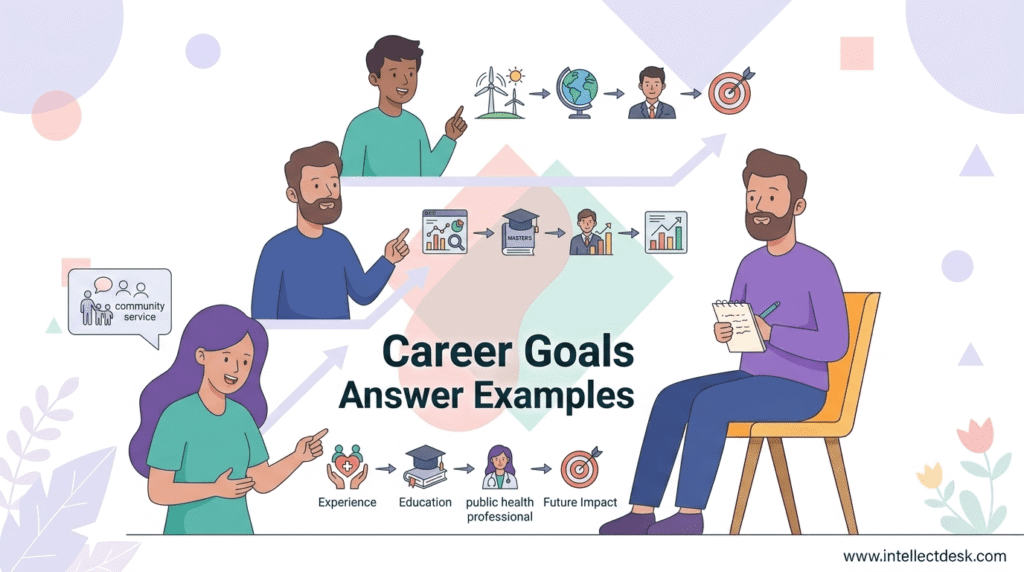
Master’s Example
“My undergraduate studies in economics and my internship with a research organization developed my interest in economic development. I want to pursue a master’s degree to strengthen my research and analytical skills, particularly in development policy. Long term, I hope to work on research and policy projects that help improve economic opportunities in developing communities.”
Here, the student’s previous education and experience naturally lead into the master’s goal and longer-term career direction.
International Student Example
“I want to specialize in renewable energy because my academic studies have shown me how energy access can affect economic and community development. Studying internationally would allow me to gain technical knowledge and learn from different approaches to energy challenges. After completing my education, I hope to use that experience in projects that support sustainable energy development in my home region.”
The important point is that the student explains the academic and professional reasons for studying internationally rather than simply saying they want to study abroad.
What If You Are Not Sure About Your Career Goals?
Not knowing your exact career path is not necessarily a problem.
Students may still be exploring different specialties, deciding between related careers, or discovering their interests through education. You can be honest about that while still demonstrating direction.
Instead of saying: “I have no idea what I want to do.”
Explain what you do know.
For example:
“I’m still exploring whether I want to focus on clinical psychology or educational psychology, but I know I want to work in a field where I can support young people’s mental and educational development. My studies and practical experiences will help me determine which specialization is the best fit.”
This answer acknowledges uncertainty while showing that the student has a clear field of interest and a reason for continuing to explore it.
You do not need to invent a specific job title simply because you think the interviewer expects one. If you are stuck with any other question, check out this guide 35+ Scholarship Interview Questions and Answers to Help You Succeed
What If Your Career Goals Have Changed?
Changing career goals does not automatically make you look unfocused.
In many cases, changing direction shows that you have learned from your experiences and thought carefully about what you want.
A useful structure is: Previous Interest → What Changed → What You Learned → Current Direction
For example:
“I originally planned to study business because I was interested in entrepreneurship, but during a university project I became more interested in how businesses use technology to solve operational problems. That experience led me toward information systems, where I can combine my interest in business with technology. I now want to build a career in digital business strategy.”
The important thing is to explain the reasoning behind the change rather than treating it as something you need to hide.
Common Mistakes When Answering This Question
1. Being too vague: “I want to be successful” does not tell the interviewer what you actually want to pursue.
2. Giving unrealistic goals: You do not need to promise that you will completely transform an entire industry. Set meaningful but believable goals.
3. Naming a career without explaining why: Simply saying “I want to become a lawyer” is less useful than explaining what led you toward law.
4. Focusing only on salary or prestige: Financial stability can be a legitimate personal goal, but it should not be the entire explanation for your career choice.
5. Giving goals unrelated to your degree: If there is an apparent disconnect, explain how your education provides transferable skills or prepares you for the direction you have chosen.
6. Forgetting the scholarship connection: Do not stop after explaining your career plans. Show how the scholarship supports the next step.
7. Pretending to have everything figured out: Career plans can change. A thoughtful direction is more convincing than a perfectly detailed future that does not sound genuine.
8. Memorizing an unnatural script: Prepare your key ideas and examples, but leave enough flexibility to speak naturally.
If you need more help with mistakes and how to neglect them in interview, this guide 15 Common Scholarship Interview Questions and Answers to Avoid Mistakes by Intellect Desk will help you to succeed.
How Long Should Your Career Goals Answer Be?
A response of approximately 60–90 seconds is a useful target unless the interviewer asks for more detail.
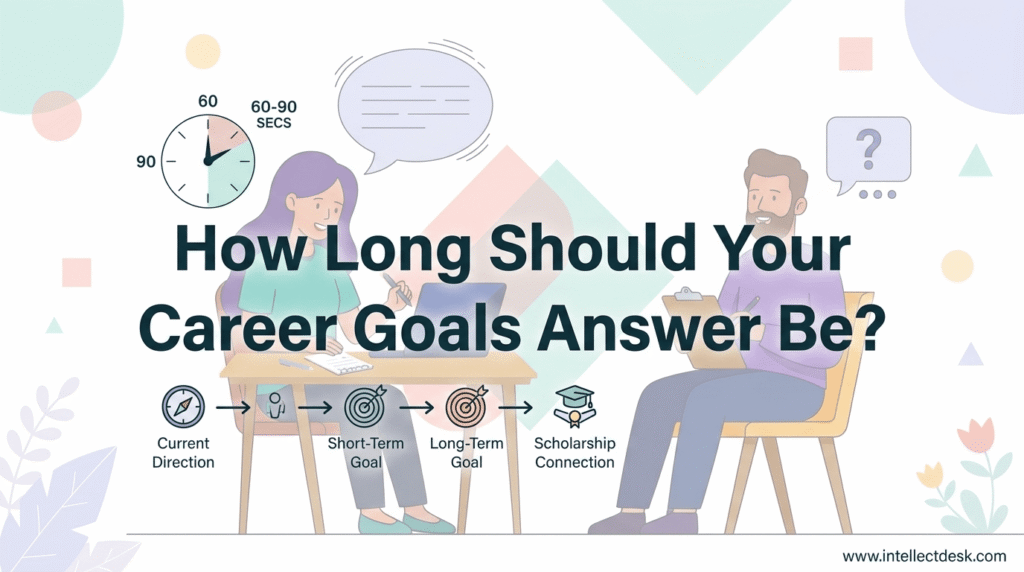
That gives you enough time to explain your current direction, short-term goal, long-term goal, and scholarship connection without turning your response into a complete career biography.
Keep the answer specific and focused. If the interviewer wants more information, they can ask a follow-up question.
Quick Career Goals Answer Formula
A simple formula to remember is:
I am interested in → I am preparing for → I want to become → This scholarship will help me
For example:
“I’m interested in computer science because I enjoy solving practical problems with technology. I’m preparing to study software development at university, with the long-term goal of creating educational technology. This scholarship would help me gain the education and skills needed to begin that career.”
Use the formula as a guide rather than memorizing these exact words.
Frequently Asked Questions
How do I answer “What are your career goals?” in a scholarship interview?
Explain the field you are interested in, what you want to accomplish in the short term, where you hope your career will lead, and how the scholarship supports your educational or professional plans.
What should I say if I am unsure about my career goals?
Be honest about what you are still exploring, but explain the field or type of work that interests you. Show that you have a direction even if you have not selected a precise job title.
Should my career goals match my degree?
Ideally, there should be a logical connection between your degree and career plans. If your goals are different from your degree, explain how the skills and knowledge from your education support your intended direction.
Should I mention long-term career goals in a scholarship interview?
Yes. A long-term goal can show the interviewer where you hope your education will lead. However, keep it realistic and avoid pretending that you can predict every detail of your future.
How do I connect my career goals to the scholarship?
Identify a specific way the scholarship will support your education or professional development, such as tuition, research, an internship, specialized training, or the ability to focus more on your studies.
Conclusion
A strong career goals scholarship interview question answer should give the interviewer a clear sense of where you are heading and why.
Explain your current direction, identify realistic short-term and long-term goals, show how your education prepares you for that path, and connect the scholarship to a specific step toward achieving those goals.
You do not need to have your entire career planned. What matters is demonstrating thoughtful direction, genuine motivation, and a realistic understanding of how your education can help you reach your goals.
If your plans change, explain what you learned and why your current direction makes sense. Above all, be specific but honest. A genuine career plan is more convincing than an impressive answer you do not actually believe.


One Comment