
9 Scholarship Interview Preparation Tips: How to Prepare and Succeed
A scholarship interview can feel difficult because you may not know exactly what the interviewers will ask or how much preparation is enough. The good news is that you do not need to memorize perfect answers.
The best way to learn how to prepare for scholarship interview situations is to focus on what you can control: understand the scholarship, research the organization, review your application, prepare relevant experiences, practice speaking aloud, organize your documents, and arrive ready for a natural conversation.
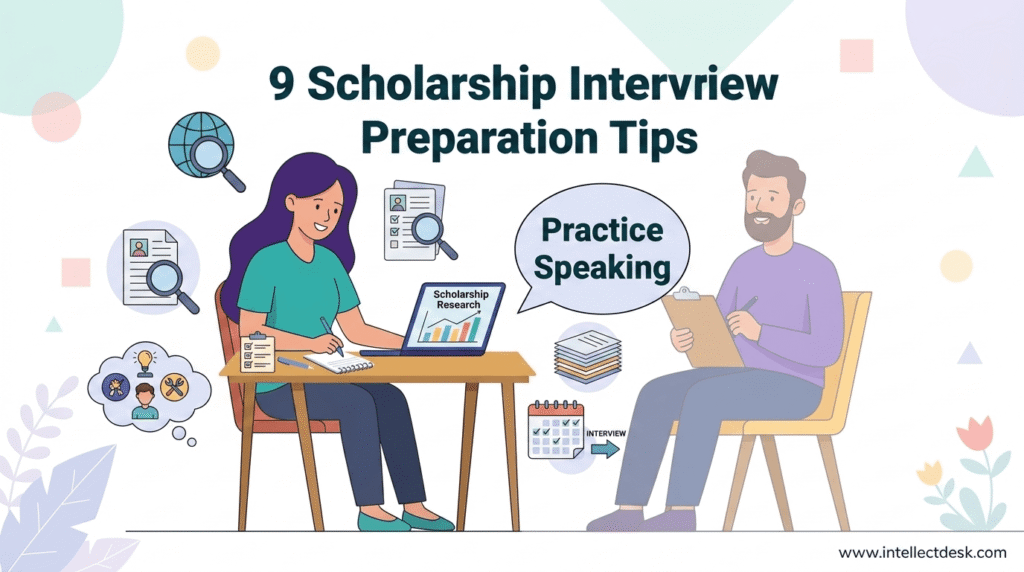
This step-by-step scholarship interview preparation guide will help you turn those tasks into a simple plan.
What to Do Before a Scholarship Interview?
Effective preparation can be divided into nine practical steps:
- Research the scholarship.
- Research the organization behind it.
- Review your own application.
- Prepare for likely question categories.
- Prepare personal stories and evidence.
- Practice without memorizing scripts.
- Complete mock interviews.
- Organize documents and interview logistics.
- Prepare questions to ask the interviewer.
You do not need to spend equal time on every step. Focus most on understanding your application, connecting your experiences to the scholarship’s purpose, and practicing how you explain your experiences clearly.
1. Research the Scholarship
Start with the scholarship itself. Read the official scholarship page and application information carefully rather than relying only on summaries from other websites.
Find out:
- The scholarship name and sponsoring organization
- Eligibility requirements
- Selection criteria
- Scholarship values or mission
- Award amount and benefits
- Field-of-study requirements
- Academic expectations
- Leadership or community-service expectations
- Application requirements
- Qualities the selection committee says it values
- Previous recipients, if publicly available
The purpose of this research is not to memorize facts. You want to understand what the scholarship is designed to support.
For example, if a scholarship emphasizes community service, identify the specific language used to describe that priority. Then think about your own experience that demonstrates your involvement in your community.
A useful approach is to write down 3–5 important details from the scholarship description. Next to each detail, note one experience, achievement, or goal from your own background that connects naturally to it.
This gives you useful preparation material without forcing you to invent answers.
2. Research the Organization Behind the Scholarship
The scholarship and the organization offering it are related, but they are not the same thing.
Research the sponsoring organization’s:
- Mission
- Core values
- History
- Main programs and initiatives
- Community involvement
- Recent projects or achievements
- Reason for offering the scholarship
- Students, communities, or causes it supports
This can help you understand the broader purpose behind the award.
For instance, suppose an organization supports students interested in improving their local communities. During your preparation, you might identify a volunteer project you participated in and think about what it taught you. You can then explain that experience naturally if a relevant topic comes up.
Do not pretend to support an organization’s values simply because you think it will impress the interviewers. Research should help you understand the scholarship’s purpose and identify genuine connections between your background and what the organization supports.
3. Review Your Own Application
One of the most important scholarship interview preparation steps is surprisingly simple: read your own application again.
Interviewers may ask about information you already submitted, so you should be comfortable discussing everything you included.
Review your:
- Personal statement
- Essays
- Resume or CV
- Academic achievements
- Extracurricular activities
- Volunteer work
- Leadership experiences
- Work experience
- Awards
- Career goals
- Relevant financial information
- Projects and accomplishments
Look for claims or experiences that could naturally lead to follow-up questions.
If your application says you led a school project, for example, be ready to explain what your role was, what problem you faced, what you did, and what happened afterward.
Do not memorize your application word-for-word. Instead, make sure your interview responses remain consistent with what you submitted.
4. Prepare for Likely Scholarship Interview Questions
You should prepare for common question categories, but you do not need to create a memorized response for every possible question.
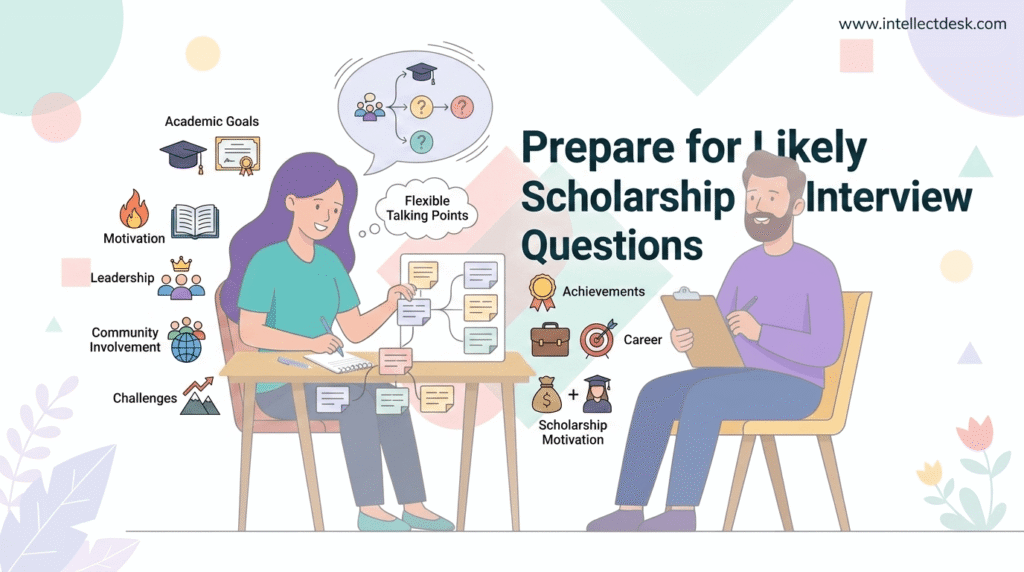
Think about topics such as:
- Your background
- Academic goals
- Motivation
- Leadership
- Community involvement
- Challenges
- Achievements
- Career plans
- Why you applied
- How would the scholarship help you
The goal is to prepare useful talking points and examples that you can adapt.
For the full range of questions you may encounter, see our guide to scholarship interview questions. If one particular question requires more preparation, you can also review our guides on “Tell Me About Yourself” scholarship interview answers, “Why Do You Deserve This Scholarship?”, and career goals scholarship interview answers.
The important distinction is that those resources help you work on individual questions; this article focuses on how to prepare before the interview.
5. Prepare Your Personal Stories and Evidence
Instead of preparing dozens of separate answers, prepare 4–6 important experiences or stories from your life.
Choose experiences such as:
- An important achievement
- A challenge you overcame
- A leadership experience
- Community service
- An academic project
- A failure that taught you something
- An experience that influenced your career goals
For each story, organize your thoughts using:
Situation → Action → Result → Lesson
Start by explaining the situation briefly. Then describe what you actually did, what happened as a result, and what you learned.
For example, if you volunteered to organize a community event, do not stop at saying that you volunteered. Think about the problem, your specific responsibility, the result, and what the experience taught you.
This preparation method is useful because one experience can support several different conversations. A leadership story might also demonstrate problem-solving, teamwork, responsibility, or personal growth.
You are not memorizing a story to repeat exactly. You are preparing evidence that helps you speak about your experiences clearly.
6. Practice Your Answers Without Memorizing Them
There is an important difference between practicing an answer and memorizing a script.
When you memorize every sentence, you may become focused on remembering the exact wording instead of listening to the question. If the interviewer phrases the question differently or asks a follow-up, a memorized response can become difficult to adapt.
Instead, practice from short bullet points.
For example, instead of memorizing a paragraph about a leadership experience, your notes might say:
- School science project
- Three-person team
- Missed first deadline
- Reorganized responsibilities
- Finished successfully
- Learned to communicate earlier
Then practice explaining those points in your own words.
Practice aloud rather than only reading silently. Record yourself occasionally and listen for unnecessary repetition, unclear explanations, overly long answers, or frequent filler words.
Try answering the same topic in slightly different ways. This helps you sound prepared without sounding rehearsed.
7. Use Mock Interviews
A mock interview can reveal problems that are difficult to notice when practicing alone.
Practice With a Person
Ask a teacher, parent, mentor, counselor, friend, or advisor to conduct a practice interview.
Ask them not only to read prepared questions but also to interrupt with realistic follow-ups.
For example:
- “Can you tell me more about that?”
- “Why was that important to you?”
- “What did you learn from that experience?”
Afterward, ask for specific feedback. Was your answer clear? Did you actually answer the question? Were your examples specific? Did you spend too much time on background information?
Record Yourself
A phone or computer can work as a simple practice tool.
Review your recording for:
- Clarity
- Speaking pace
- Repeated phrases
- Filler words
- Answer length
- Whether you explain the evidence clearly
- Whether you directly address the question
The goal is not to look or sound perfect. The recording helps you identify one or two areas to improve before the real interview.
8. Prepare Your Documents and Materials
Prepare your materials before interview day so you are not searching for important information at the last minute.
Depending on the scholarship and interview instructions, you may need:
- A copy of your scholarship application
- Resume or CV
- Personal statement
- Relevant certificates
- Academic records, if requested
- Identification, if required
- Portfolio or project materials, when relevant
- Interview invitation or instructions
- Contact information
- Notebook and pen
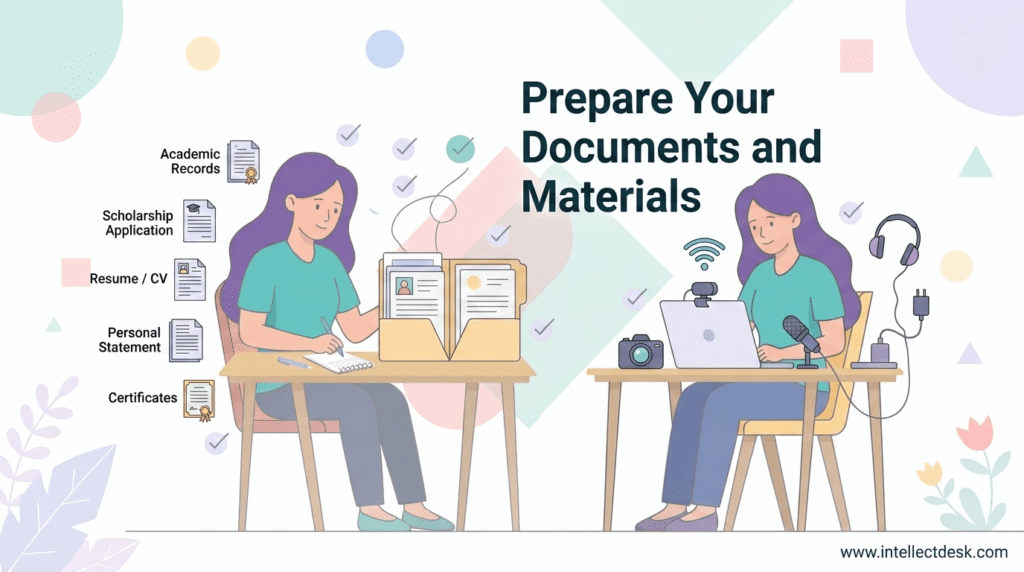
Only bring documents that are requested or genuinely relevant. More paperwork does not automatically make you look more prepared.
For an online interview, check your:
- Device
- Charger
- Internet connection
- Required video-conferencing software
- Camera
- Microphone
- Interview location
Do a complete technology test before the interview rather than discovering a microphone or software problem minutes before it starts.
9. Prepare Questions to Ask the Interviewer
Many scholarship interviews end by giving applicants an opportunity to ask questions. Preparing one or two thoughtful questions is better than reaching the end and saying you have nothing to ask.
Useful questions may include:
- What qualities have successful scholarship recipients demonstrated?
- What opportunities are available to scholarship recipients beyond financial support?
- How does the organization support students during the scholarship period?
- What do you hope scholarship recipients will accomplish?
- Are there mentorship, networking, or community opportunities connected with the scholarship?
- What are the next steps in the selection process?
Choose 1–3 questions that genuinely interest you.
Do not ask a question simply because you think it will impress the interviewer. A genuine question usually leads to a more natural conversation.
Create a Scholarship Interview Preparation Timeline
You do not need to do everything the night before. Spread your scholarship interview preparation across several days.
One Week Before
- Research the scholarship.
- Research the sponsoring organization.
- Review your application.
- Select 4–6 important experiences.
- Prepare talking points.
- Begin mock interviews.
2–3 Days Before
- Complete a full mock interview.
- Identify and improve weak areas.
- Confirm required documents.
- Confirm the interview time and location.
- Test your technology if the interview is online.
- Prepare 1–3 questions for the interviewer.
The Day Before
- Do a light review of your notes.
- Prepare your clothing and materials.
- Confirm travel or online meeting details.
- Avoid trying to memorize everything.
- Get adequate rest.
On Interview Day
- Check your technology or travel route.
- Have the requested documents ready.
- Arrive or join early.
- Review only brief notes.
- Listen carefully to each question.
- Give yourself a moment to think when necessary.
- Focus on having a genuine conversation rather than reciting prepared speeches.
Scholarship Interview Preparation Checklist
Use this checklist before your interview:
- I researched the scholarship.
- I researched the sponsoring organization.
- I reviewed my application.
- I prepared 4–6 important experiences or stories.
- I reviewed the likely question categories.
- I practiced answers aloud.
- I completed at least one mock interview.
- I practiced responding to follow-up questions.
- I prepared the required documents.
- I prepared 1–3 questions to ask.
- I confirmed the interview time and format.
- I tested my technology if necessary.
- I know where to go or how to join online.
- I am prepared to speak naturally instead of reciting scripts.
What NOT to Do During Scholarship Interview Preparation
Avoid these common preparation mistakes:
- Do not memorize every answer word-for-word. Prepare ideas and evidence instead.
- Do not research only the scholarship. Understand the organization behind it as well.
- Do not forget your application. Be ready to discuss the experiences and achievements you submitted.
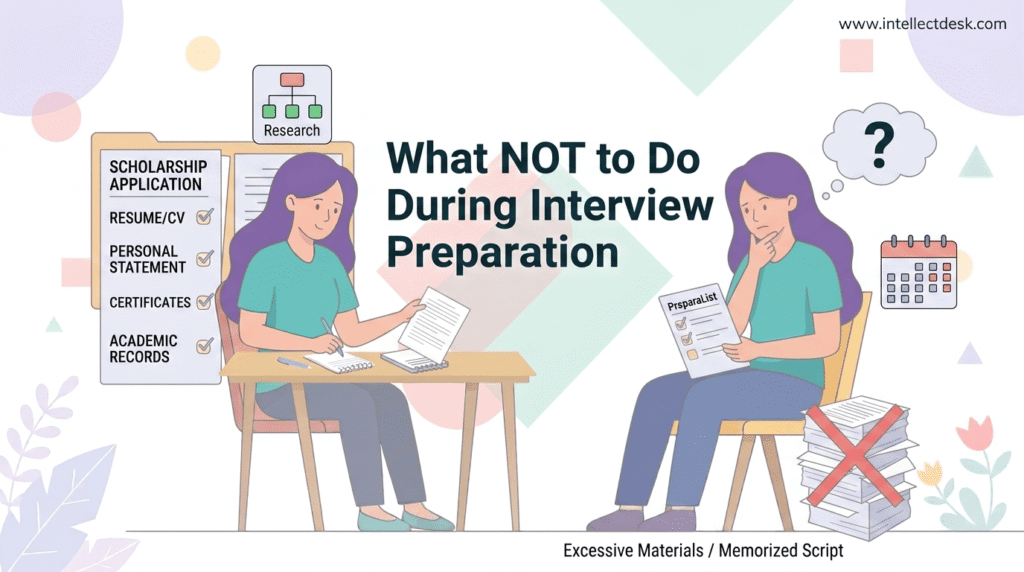
- Do not prepare only perfect answers. Practice unexpected follow-up questions too.
- Do not wait until the night before. Give yourself time to identify and fix weak areas.
- Do not bring unnecessary documents. Follow the interview instructions.
- Do not prepare questions just for the sake of asking something. Choose questions you genuinely want answered.
Frequently Asked Questions
How early should I start preparing for a scholarship interview?
Ideally, start about a week before the interview. This gives you enough time to research the scholarship, review your application, prepare stories, practice aloud, complete a mock interview, and organize logistics without rushing.
What should I research before a scholarship interview?
Research the scholarship’s eligibility requirements, selection criteria, mission, benefits, expectations, and stated values. Also research the sponsoring organization’s mission, programs, history, and reason for offering the scholarship.
How should I practice for a scholarship interview?
Practice speaking aloud rather than silently reading answers. Use bullet-point notes, record yourself, and complete at least one mock interview with another person. Include unexpected follow-up questions in your practice.
What should I bring to a scholarship interview?
Bring only materials requested or genuinely relevant, such as your application, resume, personal statement, requested academic records, identification, or relevant project materials. For online interviews, prepare your device, charger, internet connection, camera, microphone, and required software.
Should I memorize my scholarship interview answers?
No. Memorizing answers word-for-word can make your responses sound rehearsed and make it harder to handle unexpected questions. Prepare key points, examples, and stories that you can explain naturally.
What questions should I ask at the end of a scholarship interview?
Prepare one to three genuine questions about the scholarship experience, recipient opportunities, mentorship, support, expectations, or the next steps in the selection process. Choose questions that were not already answered during the interview.
Conclusion
Learning how to prepare for scholarship interview situations is less about creating perfect speeches and more about being thoroughly prepared.
Use this simple process: Research → Review → Prepare → Practice → Organize → Ask
Understand what the scholarship supports, learn about the organization, review what you submitted, prepare a few strong experiences, practice speaking naturally, organize your materials, and prepare genuine questions.
When you do that preparation in advance, you are not relying on memorized answers. You are building enough understanding of your own experiences, goals, and application to handle the interview naturally.

One Comment