
35+ Scholarship Interview Questions and Answers to Help You Succeed
Preparing for a scholarship interview can feel stressful, especially when you are unsure what the interviewers might ask. The good news is that most scholarship interview questions follow common themes, including your background, academic goals, financial situation, achievements, leadership experience, and future plans.
A scholarship interview is an opportunity for the selection committee to learn more about the person behind the application. Your grades and documents may show what you have achieved, but your interview helps them understand your motivation, personality, goals, and potential.
In this guide, you will learn:
- What is a scholarship interview?
- How to prepare before the interview?
- More than 30 common scholarship interview questions
- Scholarship interview questions and answers with realistic examples
- How to answer difficult questions?
- Questions you can ask interviewers
- Common mistakes to avoid
- Tips for online scholarship interviews
- What to do after your interview
Every scholarship program is different, so no list can predict every question. However, preparing for the most common topics can help you feel more confident and give clearer, more thoughtful answers.
What Is a Scholarship Interview?
Scholarship organizations may conduct interviews because several applicants have similar academic records or qualifications. The interview can help them determine which candidates are the best fit for the scholarship’s goals and values.
Interviewers may evaluate:
- Your communication skills
- Your academic interests
- Your educational goals
- Your career plans
- Your motivation
- Your leadership experience
- Your community involvement
- Your understanding of the scholarship
- Your financial circumstances, when relevant
- Your ability to explain your experiences honestly
How Is a Scholarship Interview Different From a Job Interview?
A job interview usually focuses on whether you can perform a specific role for an employer.
A scholarship interview focuses more on your potential as a student and how the scholarship may support your educational journey. Interviewers may be interested in your goals, achievements, character, challenges, and future plans.
How Is It Different From a University Admissions Interview?
A university admissions interview may focus on whether you are a good fit for a particular institution or academic program.
A scholarship interview is more focused on why you are a suitable candidate for financial support or recognition. Depending on the scholarship, the committee may also evaluate leadership, community service, academic performance, financial need, or a specific area of interest.
How to Prepare for a Scholarship Interview?
Good preparation does not mean memorizing perfect answers. It means understanding your experiences well enough to discuss them clearly and confidently. Below are the few professional scholarship interview preparation tips.
1. Research the Scholarship Organization
Learn about:
- The organization’s mission
- The purpose of the scholarship
- Who funds or supports it
- The type of students it aims to help
- Its values and priorities
For example, if a scholarship strongly focuses on community leadership, prepare examples that demonstrate how you have helped others or taken responsibility.
2. Understand the Scholarship Requirements
Read the scholarship description again before your interview.
Ask yourself:
- Why did I apply?
- What qualities does this scholarship value?
- Which parts of my experience match those qualities?
- What are the scholarship’s goals?
This will help you connect your answers to the opportunity naturally.
3. Review Your Application
Interviewers may ask about information you included in:
Your personal statement, Scholarship essay, Academic history, Extracurricular activities, Volunteer work, and leadership roles.
Read your application before the interview so you can discuss it confidently.
4. Prepare Examples From Your Life
Think about situations involving:
Academic achievements, Challenges, Leadership, Teamwork, Community service, Failure, Problem-solving, and Personal growth.
Specific examples usually make answers stronger than general statements.
5. Practice Answering Questions
Practice out loud instead of only reading answers silently. You can practice with your parents, teachers, close friends, mentors, and classmates.
Ask them to give feedback on whether your answers are clear and natural.
6. Prepare Important Documents
Depending on the scholarship, you may need:
- Identification
- Interview invitation details
- Academic records
- Resume or CV
- Portfolio
- Copies of your application
Always follow the instructions provided by the scholarship organization. You can also follow scholarship interview tips guide provided by Intellect Desk.
7. Choose Appropriate Clothing
Wear clean, appropriate clothing suitable for the interview setting.
You do not always need extremely formal clothing, but avoid looking unprepared. If the scholarship organization provides a dress code, follow it.
8. Test Technology for Online Interviews
Before an online interview, test:
- Your internet connection
- Camera
- Microphone
- Meeting software
- Headphones, if using them
- Device battery or charger
Do not wait until the interview starts to discover a technical problem.
Most Common Scholarship Interview Questions
Below are realistic scholarship interview questions organized by category.
Personal Background Questions
- Tell us about yourself.
- What are your greatest strengths?
- What is one weakness you are working to improve?
- What is a major challenge you have overcome?
- What achievement are you most proud of?
- What motivates you to succeed?
Academic Questions
- Why did you choose your field of study?
- What academic achievement are you most proud of?
- Which subject do you enjoy the most and why?
- What are your future educational goals?
- How do you manage academic pressure?
- Describe a time when you struggled academically and what you did.
Scholarship and Financial Need Questions
- Why do you deserve this scholarship?
- Why did you apply for this scholarship?
- How will this scholarship help you achieve your goals?
- What would receiving this scholarship mean to you?
- How would you use the scholarship funds?
- How would your education be affected if you did not receive this scholarship?
Career and Future Goals Questions
- What career do you want to pursue?
- Where do you see yourself in five or ten years?
- How will your education help you achieve your goals?
- What impact do you hope to make in your career?
- What problems in your field would you like to help solve?
Leadership and Community Questions
- Describe a time when you demonstrated leadership.
- How have you contributed to your community?
- Tell us about a time you worked as part of a team.
- Describe a situation where you helped someone.
- What extracurricular activities are important to you?
Difficult or Unexpected Questions
- Tell us about a failure and what you learned from it.
- What would you do if you disagreed with a team leader?
- Why should we choose you instead of another candidate?
- What is something not included in your application that we should know?
- If you could change one decision you made, what would it be?
- What would you do if you did not receive this scholarship?
- What is the biggest challenge facing students today?
- Describe a time when you made a difficult decision.
Scholarship Interview Questions and Answers
The following examples are not scripts to memorize. Use them to understand how a strong answer can be structured and then adapt the ideas to your real experiences.
1. Tell Us About Yourself
What the interviewer wants to know: The interviewer wants a short introduction that explains who you are, what you are studying or planning to study, and what matters to you.
How to answer: Focus on your current educational stage, academic interests, relevant achievements or activities, and future goals.
Avoid telling your entire life story.
Example answer: “I am currently a final-year high school student with a strong interest in computer science. Over the past two years, I have become particularly interested in how technology can solve everyday problems. I have also helped younger students at my school learn basic computer skills. My goal is to study computer science at university and eventually work on technology projects that make education more accessible.”
Avoid: Do not give an extremely long answer or repeat every detail from your application.
2. Why Did You Apply for This Scholarship?
What the interviewer wants to know: Whether you understand the scholarship and have a genuine reason for applying.
How to answer: Explain why the opportunity interests you, how it relates to your goals, and how the support could help your education.
Example answer: “I applied because this scholarship would help me continue my education with less financial pressure. I was also interested in the scholarship’s focus on supporting students who demonstrate academic commitment and community involvement. Those are areas I have tried to develop throughout my studies, so I felt this opportunity matched both my needs and my goals.”
Avoid: Do not simply say, “I applied because I need money.” Financial need may be relevant, but your answer should explain the broader value of the opportunity.
3. Why Do You Deserve This Scholarship?
What the interviewer wants to know: The committee wants to understand what makes you a strong candidate without expecting you to compare yourself negatively or aggressively with other applicants.
How to answer: Connect your achievements, efforts, goals, and potential to fit with the scholarship.
Example answer: “I believe I am a strong candidate because I have worked consistently toward my academic goals while also trying to contribute outside the classroom. I am proud of my academic progress, but I also value the volunteer work I have done helping younger students with their studies. If selected, I would use this opportunity to continue my education and build skills that I can later use to contribute to my community.”
Avoid: Do not sound entitled or suggest that other applicants are less deserving.
4. What Are Your Greatest Strengths?
What the interviewer wants to know: Understand your self-awareness and identify qualities that may help you succeed.
How to answer: Choose one or two genuine strengths and support them with an example.
Example answer: “One of my strengths is persistence. When I find something difficult, I try to understand it rather than giving up quickly. For example, I initially struggled with mathematics during one semester, so I started attending extra study sessions and practicing regularly. My results improved, but more importantly, I learned how to approach difficult subjects with patience.”
Avoid: Do not list several strengths without evidence.
5. What Is a Challenge You Have Overcome?
What the interviewer wants to know: How you respond to difficulties.
How to answer: Briefly explain the challenge, what you did, and what you learned.
Example answer: “One challenge I faced was balancing my studies with responsibilities at home. At first, I found it difficult to manage my time, and my study routine was inconsistent. I started planning my week and dividing larger assignments into smaller tasks. Over time, I became more organized and learned the importance of planning ahead.”
Avoid: Do not exaggerate your experience or provide unnecessary personal details.
6. Why Did You Choose Your Field of Study?
What the interviewer wants to know: Whether you have thought seriously about your academic direction.
How to answer: Explain what interested you and how the field connects to your future.
Example answer: “I chose environmental science because I became interested in how environmental problems affect communities and daily life. As I learned more about issues such as pollution and resource management, I realized that I wanted to understand these challenges in greater depth. I hope to develop knowledge that allows me to work on practical environmental solutions in the future.”
Avoid: Do not give an answer that sounds copied from a website.
7. What Academic Achievement Are You Most Proud Of?
What the interviewer wants to know: Understand what you value and how you achieved something meaningful.
How to answer: Explain the achievement and the effort behind it.
Example answer: “I am most proud of improving my performance in a subject that I initially found difficult. I did not achieve my goal immediately, but I changed my study habits and asked for help when I needed it. The improvement showed me that progress often comes from consistency rather than natural ability alone.”
Avoid: Do not simply state a grade or award without explaining why it matters.
8. How Will This Scholarship Help You Achieve Your Goals?
What the interviewer wants to know: Understand the practical impact of their support.
How to answer: Connect the scholarship directly to your educational journey.
Example answer: “This scholarship would reduce some of the financial pressure connected with my education and allow me to focus more effectively on my academic work. It would also help me continue developing the skills I need for my future career. My goal is to complete my degree and build practical experience in my field, and this support would make that path more manageable.”
Avoid: Do not promise unrealistic outcomes.
9. Where Do You See Yourself in Five or Ten Years?
What the interviewer wants to know: Understand whether you have direction and realistic goals.
How to answer: You do not need to know your exact future. Explain your current direction.
Example answer: “In five years, I hope to have completed my degree and started gaining professional experience in my field. In the longer term, I would like to take on work that allows me to solve meaningful problems and continue learning. I know my plans may develop as I gain more experience, but I am committed to building a career connected to my current academic interests.”
Avoid: Do not feel pressured to provide an exact job title or life plan.
You can also check our detailed guide about 7 Smart Ways to Answer “What Are Your Career Goals?
10. Describe a Time When You Demonstrated Leadership
What the interviewer wants to know: They want a real example of how you take responsibility or help a group move forward.
How to answer: Use a specific situation.
Example answer: “During a group project, our team was falling behind because we had not clearly divided responsibilities. I suggested creating a simple schedule and assigning tasks based on each person’s strengths. I was not the official group leader, but I helped organize the work and made sure everyone had an opportunity to contribute. We completed the project on time, and I learned that leadership can involve helping a team become more organized.”
Avoid: Do not assume leadership only means having an official title.
11. Tell Us About a Failure and What You Learned
What the interviewer wants to know: See maturity, honesty, and your ability to learn from mistakes.
How to answer: Choose a real failure that is appropriate to discuss. Focus on what changed afterward.
Example answer: “I once underestimated the amount of preparation required for an important academic presentation. I focused too much on gathering information and not enough on practicing how I would explain it. The presentation did not go as well as I had hoped. Afterward, I started preparing earlier and practicing presentations out loud. That experience taught me that good preparation involves both knowledge and communication.”
Avoid: Do not say you have never failed.
12. How Have You Contributed to Your Community?
What the interviewer wants to know: They want examples of your involvement and willingness to contribute.
How to answer: Community contribution can include formal volunteering or smaller acts of service.
Example answer: “I have helped younger students prepare for school exams by sharing study materials and explaining subjects they found difficult. It began informally, but I realized that even small support can make a difference when students feel comfortable asking questions. The experience also improved my communication skills and made me more interested in educational support.”
Avoid: Do not assume that only large volunteer projects count.
13. What Would Receiving This Scholarship Mean to You?
What the interviewer wants to know: They want to understand the personal and practical significance of the scholarship.
How to answer: Be honest and specific.
Example answer: “Receiving this scholarship would mean both practical support and encouragement. Financially, it would help reduce some of the pressure involved in continuing my education. Personally, it would motivate me to continue working toward my goals because it would show that others believe in my potential and are willing to support my educational journey.”
Avoid: Do not give a generic answer such as “It would mean everything to me” without explanation.
14. What Would You Do If You Did Not Receive This Scholarship?
What the interviewer wants to know: This question tests resilience and determination.
How to answer: Show that you value the scholarship but remain committed to your goals.
Example answer: “I would be disappointed because this scholarship would be very helpful, but I would continue looking for other opportunities and exploring ways to support my education. My long-term goal would not change. Applying for scholarships has already taught me the importance of planning and actively searching for opportunities.”
Avoid: Do not suggest that your future would completely end without one scholarship.
15. Why Should We Choose You?
What the interviewer wants to know: They want a summary of why you are a good fit.
How to answer: Briefly connect your qualifications, values, and goals.
Example answer: “I believe I would be a strong choice because I have shown commitment to my education, continued working through challenges, and have clear goals for the future. I also try to contribute to the people around me whenever possible. I understand that many applicants may have strong qualifications, but I would approach this opportunity with responsibility and use the support to continue developing academically and personally.
Avoid: Do not attack or criticize other candidates.
How to Answer Scholarship Interview Questions Effectively
Knowing the questions is helpful, but your approach to answering matters just as much.
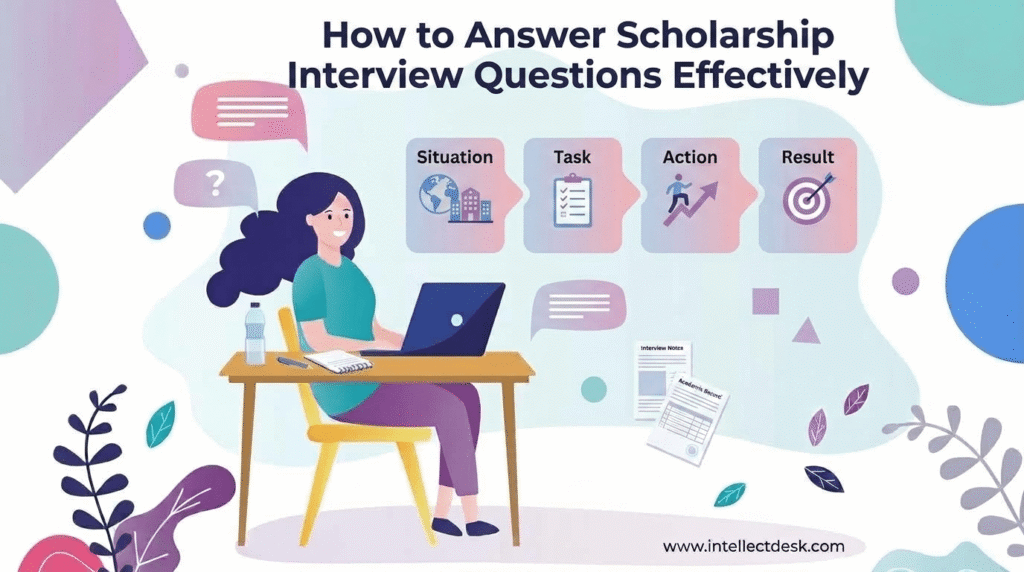
Use the STAR Method
The STAR method can help you structure answers about experiences.
S — Situation: Explain the context.
T — Task: Explain what needed to be done.
A — Action: Explain what you did.
R — Result: Explain what happened or what you learned.
STAR Method Example
Question: Tell us about a time you solved a problem.
Situation: My group was struggling to complete a project because we had different ideas.
Task: We needed to agree on a clear direction and finish the project before the deadline.
Action: I suggested that each person explain their idea, and then we identify which parts could work together.
Result: We created a better plan and completed the project on time. I learned that listening can be an important part of solving problems.
Use Specific Examples
Specific examples make your answers easier to understand and remember.
Instead of saying: “I am a good leader.“
Say: “During a group project, I organized our tasks and helped the team meet the deadline.“
Be Honest
Do not invent achievements or experiences.
If you are unsure about something, it is better to answer honestly than to create a story that you may later struggle to explain.
Connect Your Answers With Your Goals
Whenever appropriate, show how your experiences relate to your education, career interests, personal development, and your future plans.
Show Impact
Explain what happened because of your actions.
For example:
- What did you learn?
- Did a problem improve?
- Did you help someone?
- Did your approach change?
Avoid Memorized Answers
Practice your key points, but do not memorize every sentence.
A natural answer may include small pauses while you think. That is usually better than sounding like you are reciting a script.
Questions to Ask at the End of a Scholarship Interview
When interviewers ask whether you have questions, asking one or two thoughtful questions can demonstrate preparation and genuine interest.
Possible questions include:
- What qualities have successful scholarship recipients demonstrated in the past?
- What opportunities are available to scholarship recipients beyond financial support?
- Are scholarship recipients expected to participate in any activities or programs?
- How does the organization stay connected with scholarship recipients?
- What is the expected timeline for the final decision?
- Are there any future opportunities for mentorship or networking?
- What does the organization hope scholarship recipients will achieve during their studies?
- Are there responsibilities that recipients should be aware of after receiving the scholarship?
- How does the organization measure the impact of this scholarship program?
- What advice would you give to students who want to make the most of this opportunity?
Avoid asking questions that were already clearly answered in the scholarship instructions.
Scholarship Interview Mistakes to Avoid
1. Not Researching the Organization: Learn about the scholarship before the interview.
2. Giving Generic Answers: Statements such as “I am hardworking” are stronger when supported with examples.
3. Memorizing Complete Scripts: Memorized answers can sound unnatural and make it difficult to respond to follow-up questions.
4. Speaking Negatively About Others: Avoid criticizing teachers, classmates, employers, or other applicants.
5. Arriving Late: Plan ahead and allow extra time. For online interviews, join early enough to check your connection.
6. Not Preparing Examples: Prepare several examples involving challenges, achievements, teamwork, leadership, and problem-solving.
7. Focusing Only on Money: Financial need can be important, especially for need-based scholarships. However, also explain your goals and how the opportunity supports your education.
8. Giving Extremely Long Answers: Answer the question directly. If interviewers want more information, they can ask follow-up questions.
9. Ignoring Body Language: Try to:
- Sit attentively
- Maintain appropriate eye contact
- Avoid constantly looking away
- Speak clearly
10. Failing to Follow Instructions: Always follow the scholarship organization’s interview requirements and document instructions.
Scholarship Interview Tips for Online Interviews
Online interviews require additional preparation.
Check Your Internet Connection: Use the most stable connection available.
Position Your Camera Properly: Place the camera near eye level when possible.
Check Your Lighting: Your face should be visible. Avoid sitting directly in front of a bright window if it makes you appear dark on camera.
Choose a Simple Background: Find a quiet and reasonably tidy location.
Test Your Microphone: Record a short test if necessary to make sure your voice is clear.
Maintain Digital Eye Contact: When answering important questions, occasionally look toward the camera rather than constantly watching your own image.
Turn Off Notifications: Silence your phone, computer notifications, and unnecessary applications
Have a Backup Plan: Keep your charger and phone nearby, and make sure interview contact information is accessible. If you experience a technical problem, remain calm and communicate professionally.
What to Do After a Scholarship Interview?
Your work may not be completely finished after the interview.
Send a Thank-You Message When Appropriate
If the scholarship organization provides contact information and a thank-you message is appropriate, send a short and professional note.
For example: “Thank you for taking the time to speak with me today. I appreciated the opportunity to learn more about the scholarship and discuss my educational goals.”
Keep the message short.
Follow Up Professionally
Do not repeatedly contact the organization asking for updates.
If they provided a decision timeline, wait until that period has passed.
Continue Applying for Other Opportunities
Do not depend on one scholarship application. Continue searching for scholarships, grants, financial aid opportunities, university funding, and educational programs
Reflect on the Experience
After the interview, write down:
- Questions you were asked
- Answers you handled well
- Questions you found difficult
This can help you prepare for future scholarship interviews.
Conclusion
Preparing for scholarship interview questions is not about memorizing perfect responses. The best preparation is understanding your own experiences, achievements, challenges, educational goals, and reasons for applying.
Research the scholarship organization, review your application, prepare real examples, and practice answering questions naturally. Focus on being honest, specific, and clear.
Remember that scholarship committees may use different criteria depending on the purpose of the program. A strong interview cannot guarantee that you will receive a scholarship, but careful preparation can help you communicate your experiences and goals more effectively.
Before your interview, review the most common scholarship interview questions, practice a few examples using the STAR method, prepare questions for the interviewers, and make sure you understand the scholarship’s purpose.
If you are looking for something special or guides about your specific scholarship interview, you can contact us at any time.
Frequently Asked Questions
What questions are asked in a scholarship interview?
Common questions include:
- Tell us about yourself.
- Why did you apply for this scholarship?
- Why do you deserve this scholarship?
- What are your future goals?
- What challenge have you overcome?
- How will this scholarship help you?
The exact scholarship interview questions depend on the organization.
How do I introduce myself in a scholarship interview?
Give a short introduction that includes your current educational stage, academic interests, relevant activities, and future goals. Keep the answer focused on information relevant to the scholarship.
Why should we choose you for this scholarship?
Explain why you are a good match by connecting your achievements, effort, goals, and experiences with the scholarship’s purpose. Avoid sounding entitled or criticizing other applicants.
What should I wear to a scholarship interview?
Wear clean, appropriate, and professional-looking clothing suitable for the interview setting. Follow any dress instructions provided by the scholarship organization.
How long is a scholarship interview?
The length of scholarship interview questions varies depending on the organization and interview format. Follow the schedule provided in your interview invitation and prepare to answer questions clearly without rushing.
Can I say that I need the scholarship because of financial difficulties?
Yes, if financial need is relevant to the scholarship, you can explain your circumstances honestly and professionally. Also explain how the scholarship would support your education and goals.
What questions should I ask scholarship interviewers?
You can ask about the scholarship program, expectations for recipients, mentorship opportunities, future involvement, and the timeline for decisions.
How do I answer difficult scholarship interview questions?
Take a moment to think before answering. Use a clear structure, provide a genuine example where appropriate, and focus on what you learned or how you handled the situation.
What should I do if I do not know the answer to a question?
Stay calm. Ask for clarification if needed, think briefly, and answer honestly. Do not invent information.
Should I memorize scholarship interview answers?
No. Practice your main points and examples, but avoid memorizing complete scripts. Natural answers are easier to adapt to follow-up questions.

2 Comments